The Valley of the Shadow
The thorns gave way to stone. The slight cushion of soil was gone, replaced with rock that had to be trod more carefully. Solid though it was, my legs grew unsteady with each weary step. The narrow track wound downward now, carved not by human hands but by time and water long gone.
The sun bled itself out across the horizon, leaving only thin rays cast between golden clouds. Gold thinned into red, red into black. And with the blackness came the cold.
“This looks as good a place as any. We’ll rest,” Emrys said.
Before I could reply, I heard the tap of wood against stone—and suddenly a small fire crackled before us, with two stools beside it. Emrys eased himself onto one, and I surmised the other was for me. To this day, I’m still not sure if he conjured them by some quiet magic, or if they’d been there all along and I’d been too exhausted to notice.
Without hesitation, I sat. Every joint and muscle sighed in relief.
After some time resting our bodies and our minds by the fire, I asked, “Emrys, how much farther until the next town?”
I noticed the walking stick he had carried thus far was gone, replaced by a smaller one he used to poke the fire.
Emrys tilted his head, as though listening to something far off. “Beyond the valley there’s a small town. If we make it through, it’ll no’ take long to reach it.”
Part of me bristled at the if in his reply. But I knew the path was dangerous—whether from shadows that lurked or from the gnawing threat of starvation and thirst.
He must have seen my thoughts written plain on my face. To distract myself, I forced conversation.
“Ever since I fled the castle, I haven’t been able to eat or drink. Water tastes bitter. Food turns to ash. What’s happening to me?”
A spark of interest lit his face. “So ye actually saw Him?” His voice carried an eagerness, as though I’d finally touched on something worth speaking of.
“Well, yes…” I stammered, confused by his tone.
“What did ye think o’ Him?”
“The castle was more beautiful than anything I’ve ever seen,” I said, closing my eyes to remember. “Every tile, every column, each brick looked as if shaped by an artist’s hand. The people were kinder than I thought they’d be, and though there were many, it never felt crowded. I never spoke to them, but I could tell by their eyes—they weren’t looking down on me or ignoring me. It was as if they knew exactly who I was and were content with the difference. Perhaps even that they saw no difference at all.
“When I reached the banquet hall, the smell of food was unlike anything I had ever known. I could taste its goodness by the scent alone. If I’d only taken a bite, I know it wouldn’t have deceived me.” My mouth watered at the memory.
I opened my eyes. Emrys was smiling faintly, his gaze tilted toward the stars. “Aye. But what o’ His Majesty? Ye’re leavin’ out the most important part.”
I swallowed. “The King… He was different from everyone else. Brighter somehow. And yet, more inviting. I was afraid of Him—but not because He gave reason. He did nothing threatening, nothing unsettling. The opposite, really. Every word, every gesture, drew me in.”
“No, my fear came from His eyes. When He looked at me, a holy terror swept over me. It was as if He saw me—and through me. In that moment I remembered every wicked thing I’d ever done. And I knew that He knew. There was a chasm between us—an expanse between His goodness and my filth. I knew I could not stay there. That palace was made for Him. All its beauty, all its grandeur found meaning in Him. I was nothing in comparison.”
When I looked again, Emrys was wiping his face.
“Are you well?” I asked.
His voice caught, though his eyes glistened with a strange gladness. “Ye speak true, lad. But the truth ye ken is no’ yet whole. In yer tellin’, ye’ve near answered yer own question without knowin’ it.”
“It’s too late, and I’m too tired. For once, could you speak plainly?”
“Aye,” he said, leaning close to stir the embers. “Ye compared yer nothin’ness to the King’s fullness. That shows ye’ve a good mind to ken yer place. But hear me: compared to Him, everythin’ is nothin’. At the same time, He takes nothin’ and makes it everythin’. He takes dirt and makes gold. Darkness, and makes light. Beggars, and makes kings.”
“So it’s no wonder ye cannae eat nor drink now. Ye’ve sat at the King’s table. From this day on, everythin’ else will taste like ash beside His goodness.”
A great depression washed over me. “So am I never to eat or enjoy food or drink ever again?” I asked. Even as a beggar there were simple foods I could enjoy. Water is as refreshing for the poor as for the rich. Bread, if you got it soon enough after being thrown out, was a kind of treat. Eating and drinking were a couple of things in this wretched life that I had come to find joy in.
“There’s more joy to be had than that, son. Joys yet undiscovered. But the sons o’ Adam seldom seek ’em. Ye yerself are as guilty as any. Ye were met by the face o’ Joy Himself and, like yer father and yer father’s father, ye shrank back in fear. Even now ye run from what would be the greatest joy ye’ve ever kent.”
“You mean the King?” I said. “I had to run away. I didn’t belong there. He invited me by mistake. Besides, I can’t go back now. I’ll be hanged for what I’ve done.”
Emrys’ eyes glinted in the firelight. “Yer belongin’ was already decided, lad, and I can assure ye the King makes nae mistakes. If ye felt ye didna belong, it’s because ye didna want to belong. Do no’ confuse yer understandin’ wi’ the King’s.”
I didn’t like the feeling of the conversation. Yet I noticed I wasn’t tired anymore. Somehow his words angered me. He spoke of the King with a reverence I did not understand.
“You said yourself the King would kill me if I returned. If He’s as good as you say, why wouldn’t He forgive me? In fact, if He’s as good as you make Him sound, why does He never help? I’ve been a beggar all my life. He never cared an ounce for me. You say He takes nothing and makes it everything—why did He never come help me? Why was I left abandoned? I’m the nameless beggar. No one, not even the King, has ever done me any favors. Now I can’t even enjoy food because of Him. What good has come from that King?”
Emrys rose slowly. Compassion softened his eyes. “He kens yer name, lad.”
I fell silent. I remembered the invitation I had received from the King—my name written upon it. Emrys was right.
“Come now,” Emrys said, turning back to the path. “Let’s go.”
He began walking.
Still angry, but not wishing to be left alone in that place, I huffed, grabbed the crown, and followed.
“It’s dark, Emrys. Truly—it’s darker than it should be. The sun just set. It shouldn’t be like this yet. Why is it so dark?” I asked.
Emrys trudged beside me, boots scraping stone. His hat tipped low, eyes lost in shadow.
“Because ye’re closer to truth, lad. Light’s bright enough to show a feast on a table, or the flowers on the Broad Way. But truth has a way o’ lookin’ like night till ye’ve walked through it. Sometimes it even looks like a valley o’ death. All the same, we’ve got to walk through it.”
I hated the sound of that. “Your riddles never end, do they?”
He gave a grunt that might have been agreement. Or amusement. Or both.
The crown pressed against me as if it, too, knew where we were headed—heavier, colder, hungrier. I had begun to imagine its edges biting into me not by accident but with intent. Every cut whispered. Every bruise carried a voice. And in the hush of the valley, I could hear them clearly.
Why run?
Why fight?
You are already mine.
I shook my head, tried to breathe. But the valley’s air was thin, smothered by a silence that did not rest but crouched. My chest rattled with each breath, the crown pressing against it.
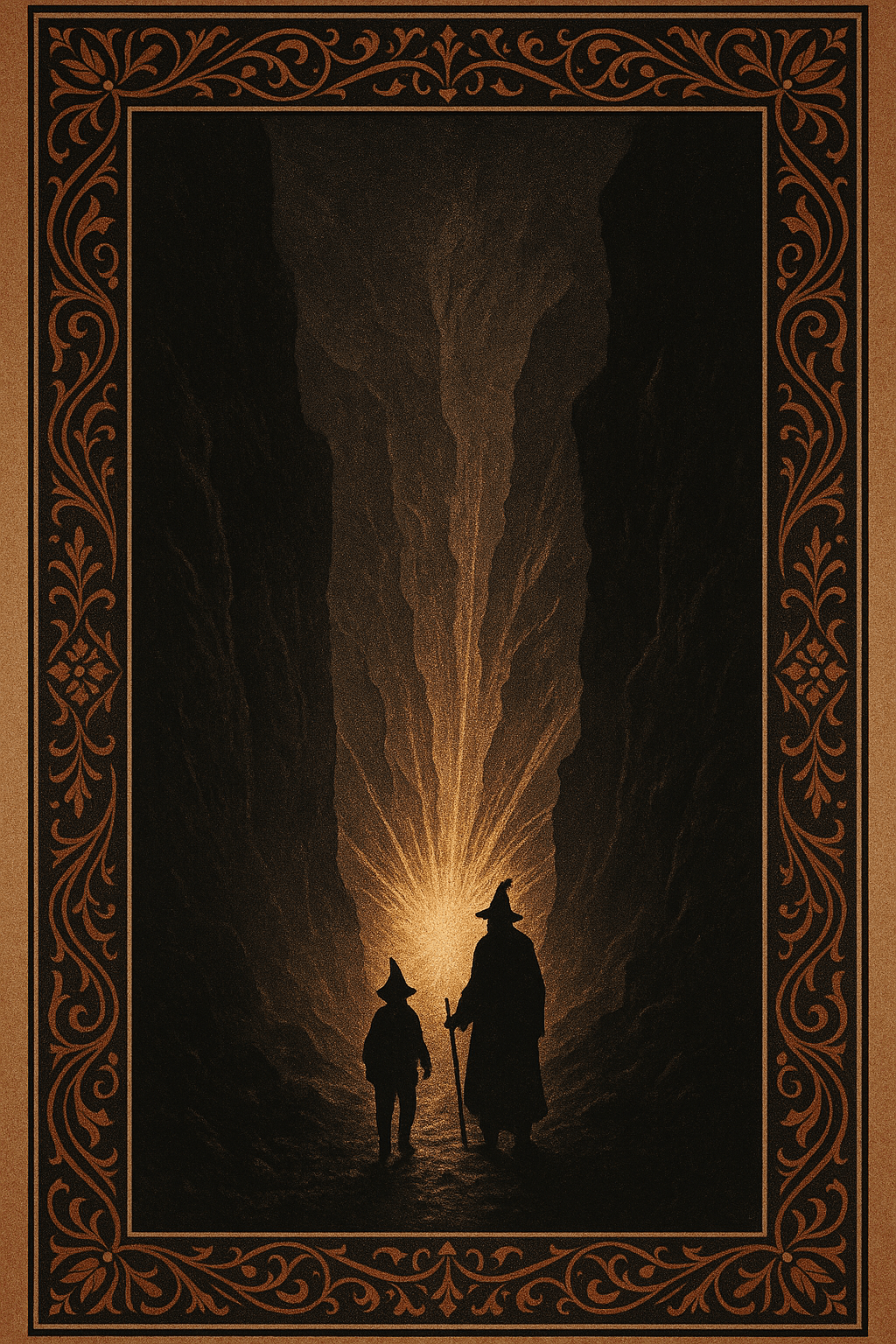
The cliffs on either side rose higher the deeper we went. They leaned inward like jaws. The path narrowed, swallowing what little light remained. I glanced back. Already the world we’d left behind was a smudge of memory. Emrys had produced something like a torch to light our way. I say like a torch because it did not resemble a flame. It gave off a cool glow—too bright to look at directly.
Forward. Always forward we marched.
The ground changed—rock to dust, dust to bone-white gravel that cracked underfoot. My steps echoed, though I didn’t want them to. Each sound came back warped, as though the valley mocked me in my own voice.
“Do you hear that?” I whispered.
“Aye,” Emrys muttered, pokin’ at the dust with his stick. “Shadows dinnae like silence. Keep walkin’.”
But I could not keep from hearing. The echoes grew clearer. No longer my voice—others. The laughter of the feast hall, sharp and accusing. The taunts of men and women who once threw coins at me in the gutter. The cries of those I had stolen from. They all jostled together, a cruel procession, marching beside me in sound.
“You’ve heard them too?” I asked.
Emrys did not look at me. “Aye.”
“When do they stop?”
He shrugged. “They don’t.”
The valley deepened. The air carried a stench now, faint but unmistakable—the sour, iron tang of rot. I held the crown tighter, though I wished I could fling it into the dark. But what good would that do? Whether in my hands or not, it felt bound to me, chained.
We turned a bend. My heart stopped.
Shadows moved.
Not like a man’s shadow, cast by light. These shadows moved without light. They swam, slid, breathed. They pooled and withdrew as if alive. Some stretched tall against the cliff walls; others crawled along the gravel like liquid night.
I stopped. “What are they?”
Emrys’s jaw clenched. He shifted his staff, planting it in the dust. “Nae shadows. Echoes. Things that try to look like nothin’, so ye’ll let them close.”
As if hearing him, one of the shapes peeled itself from the wall and slithered closer. It had no eyes, no face—yet somehow I knew it was staring at me.
I staggered back. The crown cut deeper against my arms, as though feeding the thing. “Why is it coming for me?”
“Because ye’ve got somethin’ that doesnae belong to ye,” Emrys said quietly. “And because ye believe its voice more than the King’s.”
“I don’t believe it!” I shouted, but the words tasted false.
The shadow surged, its form swelling. I stumbled. It towered, whispering with a thousand tongues.
Thief.
Traitor.
Unworthy.
I dropped to my knees, hands over my ears. “Stop it—stop!”
The shadow’s weight pressed down, heavy as stone. My body curled against the gravel. The crown slid, striking the ground with a metallic cry. At once the shadow lunged, eager, stretching talons of ink-black darkness.
A sound cut through—the sharp crack of wood. Emrys stood, staff in both hands, its end driven into the dust. Light sparked at the point of contact, rippling outward in a circle. The shadow shrieked, recoiling. The others writhed, hissing.
“Up, lad,” Emrys barked. “Ye can lie down later. Now ye walk.”
I grabbed the crown and forced myself to my feet. My legs shook, but I moved. Step by step, I followed the staff’s circle of light as Emrys pressed forward.
The shadows crowded near but did not cross the boundary. Their whispers rose, weaving lies into the very air.
He’ll never forgive you.
The valley ends in your grave.
You are alone.
But the staff glowed steady—faint, yet enough. With each strike into the dust, the light hummed like a heartbeat not my own.
We walked for what felt like hours. The valley deepened, turned upon itself, and still the shadows came. Their shapes stretched long and thin, faces forming only to collapse again. I could not tell if they were alive or only the memory of death made solid.
I wanted to ask Emrys if this would end. I wanted him to tell me the King would appear, blazing, to burn them away. But when I opened my mouth, only a ragged whisper escaped: “Why does He not come?”
Emrys didn’t answer at first. He trudged ahead, staff striking dust. Finally, he said, “Maybe ye’ve no’ yet learned how near He is.”
More riddles…
We rounded another bend. My strength was gone. Each step felt heavy as lead. My arms shook with the weight of the crown. I stumbled—and the crown fell.
The sound rang out like a bell, echoing down the valley. Every shadow froze. Then, as one, they surged.
“No—” I gasped, scrambling after it. My hands fumbled, slick with sweat.
The crown slid away, deeper into the dust. Shadows closed in, mouths wide though no mouths existed. A dozen voices screamed at once.
Mine!
I threw myself forward, hands striking gravel. My fingers closed around the crown’s cold edge. Pain lanced through me. I hauled it to my chest and curled around it like a shield.
The shadows struck.
Black fire poured over me, cold and burning at once. My vision fractured. Faces loomed: every man I’d failed, every kindness I’d spat on, every sin I’d cherished. They pressed against me, clamored for me.
And then—
A voice.
Not Emrys. Not mine. Not the shadows.
Low. Steady. The whole valley bent to hear it.
“Child, stand up. Walk.”
The words reverberated through bone and stone. The shadows recoiled as if branded. The crown seared in my hands. My breath tore in and out, but I could not let go.
Emrys’s staff struck again. Light blazed, brighter than before. The valley walls shook, stones splitting. Shadows fled, screeching, folding themselves into cracks where the light could not reach.
When at last the silence returned, it was different. Not crouching, not oppressive—waiting, patient, alive.
I lay in the dust, the crown clutched to me, tears burning my eyes.
Emrys crouched nearby, staff resting across his knees. He did not touch me. He only said, “Ye heard Him, did ye no’?”
I swallowed. My throat ached. “I… I don’t know.”
“Aye,” he murmured, eyes softer than I’d seen. “Ye do.”
We sat there for a long while. The valley did not feel so narrow now, nor the night so heavy.
At length, Emrys stood. “Come along, lad. The valley’s no’ a place to linger. Death’s shadow cannae harm ye, but it hungers all the same. Better to keep movin’. Stand up. Walk.”
He looked at me knowingly as he said it.
I rose, weak but standing. The crown still weighed like chains, but something had shifted. Not lighter—yet bearable, for the first time.
We walked on, staff striking dust, echoes fading into distance. And for the first time since I fled the feast—no, in my life—I did not feel entirely alone.
Yea, though I walk through the valley of the shadow of death, I will fear no evil: for thou art with me; thy rod and thy staff they comfort me.
Psalm 23:4


Leave a Reply